
Musing: Learning (tactile) braille
Being a beginner has some unexpected side effects
I'm a couple of months into learning to use JAWS screen-reading software. The screen-reading lessons rapidly escalated into also learning to read a refreshable braille display by touch1. Did you know that most sighted people who learn braille learn to read it visually, not by touch? I sure didn't. It had never occurred to me that teachers of the visually impaired are out there teaching braille without being able to read it the way their students are reading it. This pisses me off for reasons I haven't quite articulated, but also: learning braille tactilely is a much more intense lift than learning braille visually if you have the option to learn it visually. I can understand why tactile fluency not a requirement for sighted teachers; there are enough barriers to building blind/low vision literacy as it is.
I'd been low-key working on training my fingertip tactile sensitivity since I decided to go to grad school in the spring, on the off chance I'd develop an interest in learning tactile Braille during the process. Honestly, what obsessive reader DOESN'T want the ability to read in an entirely dark room without audio? That's superpower territory right there. At this point in the learning process, I am not shooting to get particularly near my visual reading speed, just fast enough to fact check short bits of my visual or auditory processing. There are official methods for tactile sensitivity training, but I've mostly just been finding two things that feel alike or almost alike and practicing until I can reliably tell the difference between them.
There are kinds of tactile data you can only get from your nerves via motion. I didn't know this when I started out (shout out to the first weekend workshop of grad school for inadvertently explaining why static touch was not working in some situations). Once I learned some useful movement patterns, I started unconsciously engaging in tactile-sensory-seeking fidgets using those movement patterns. All this increased tactile awareness has me unconsciously feeling for secret messages in anything with a pattern of roughly similarly shaped dots raised from a background surface: wall surface texture, concrete with pebble sized aggregate included in it, some kinds of tree bark, and some kinds of fern fronds. Most enjoyably: starfish in the tactile touch tanks at the Oregon Coast Aquarium.
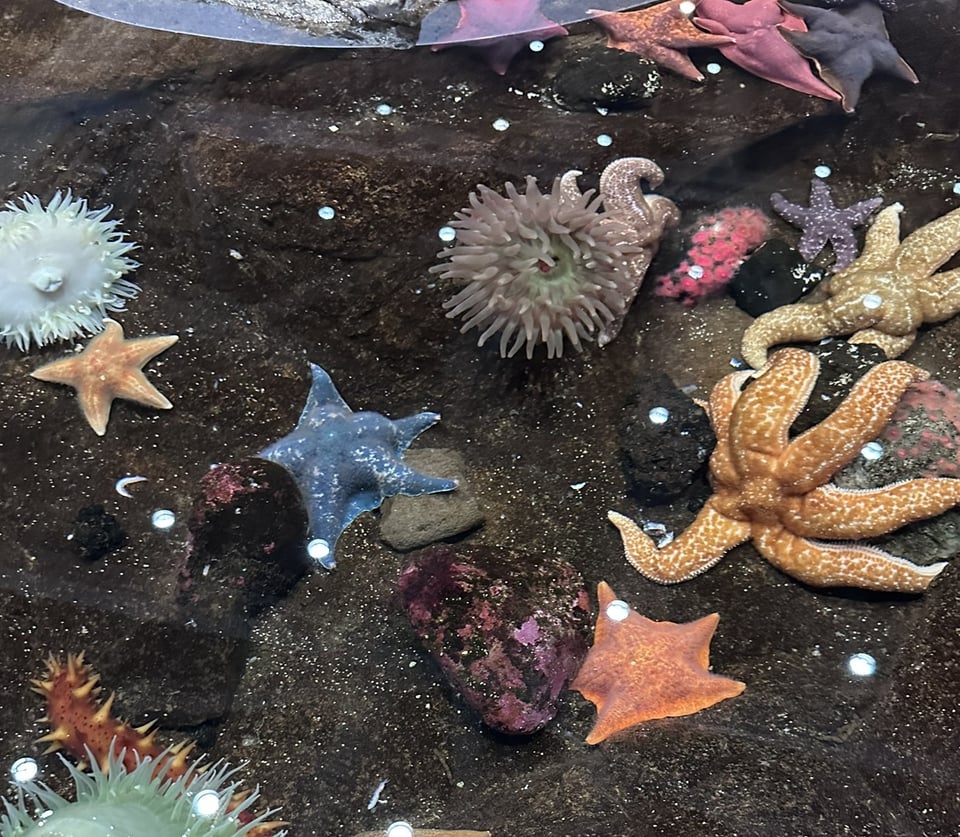
Once I moved from tactile sensitivity training to actual braille reading practice, familiar stuff started to feel different. I legit went to the dermatologist recently because I thought one of my moles had changed texture. (It hadn't, it just had texture more subtle than I'd previously been able to discern.) There are so many things I had cataloged as "very smooth" that I'm now catching nuances in, and my vocabulary for putting textures into words is starting to fall rather behind my ability to disambiguate them by touch. I find it amusing that the experience of learning new ways to form words is paired with a new realm of experience where my words fall short.
When sighted kids are acquiring reading skills in the locally dominant language in the developed world, there are printed words EVERYWHERE. One of my professors called this "incidental literacy opportunities," which is a phrase I'm obsessed with. But Braille in the wild2? Not a lot of it, and if you want it inside your home, or to, say, make flashcards, you pretty much need to acquire the means of producing it. This is... non-trivial. I ended up acquiring an old-school pressure-based vinyl tape embossing label maker that covers about 40 of the 64 possible braille cells3. And then to deal with the omissions, I invented a washi tape and self-adhesive rhinestone system for flashcards. This is not the context I imagined when I figured I'd eventually get into precision-tweezing stickers, but here me and my 3,000 rhinestones are.
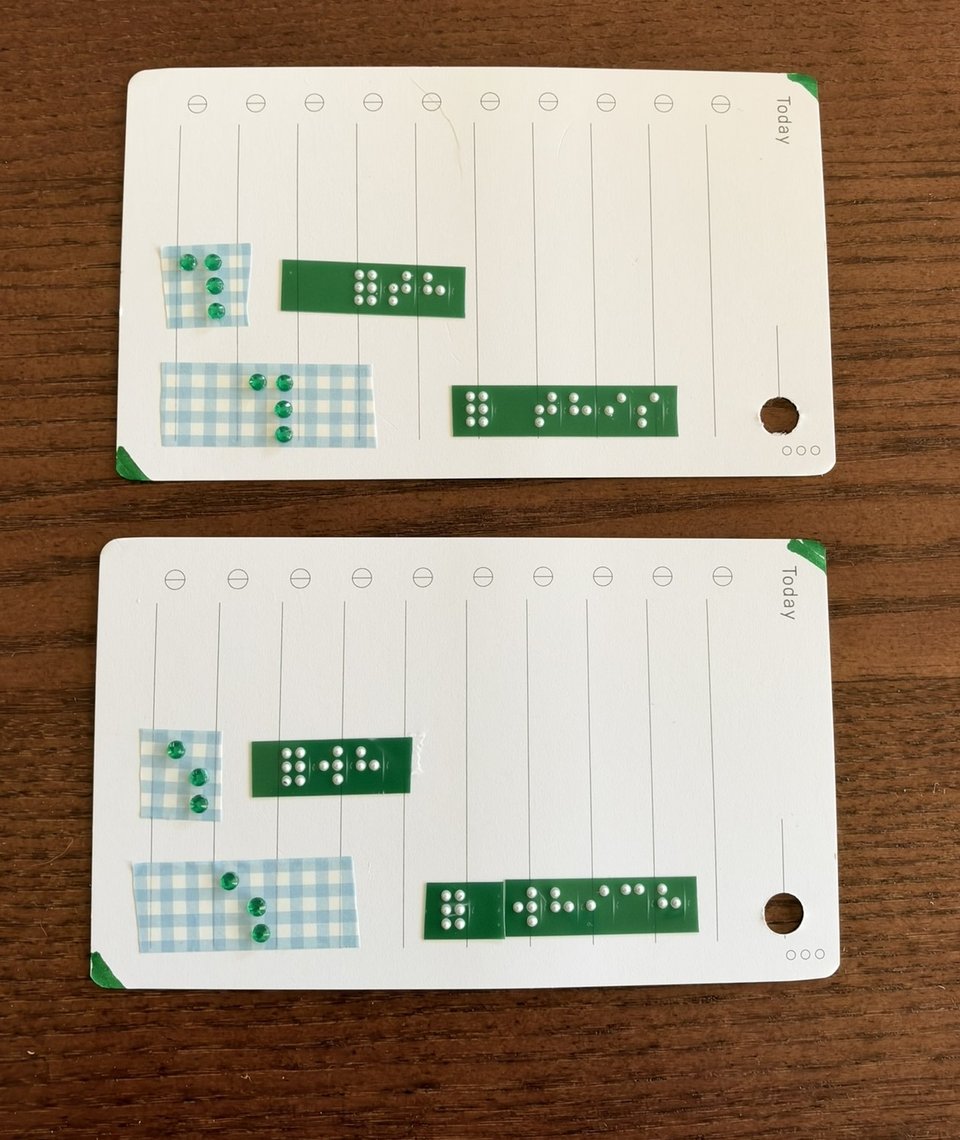
I have a long-running obsession with the visual aesthetics of particular letter and word forms, so it really shouldn't come as a surprise that I've developed strong feelings about certain braille cell combinations and phrases. Consider these:

The, still, and within take fewer characters in contracted braille than English, while small and voice both have pleasing little white space caves along their lower edges. For me, this combo means the tactile sensation of the phrase and the emotional sensation of the phrase match each other.

I'd feels like a strong declaration in braille, with a double sort of forward slash shape. The word institute begins with in-st-i which is all three possible one dot per column combos that have the left dot lower than the right dot. Paired with the sculptural tute, which ends with the backward slash of an e, the word institute feels as grandiose as it sounds.
I'm about 25% of the way into learning the "contractions" that make up contracted braille. Depending on how you set up your braille display, that means you can practice typing in braille with as many contractions as you know, then feel it get corrected to fully contracted under your fingertips. It's enchanting, a code you don't know yet trailing behind you, a word at a time.
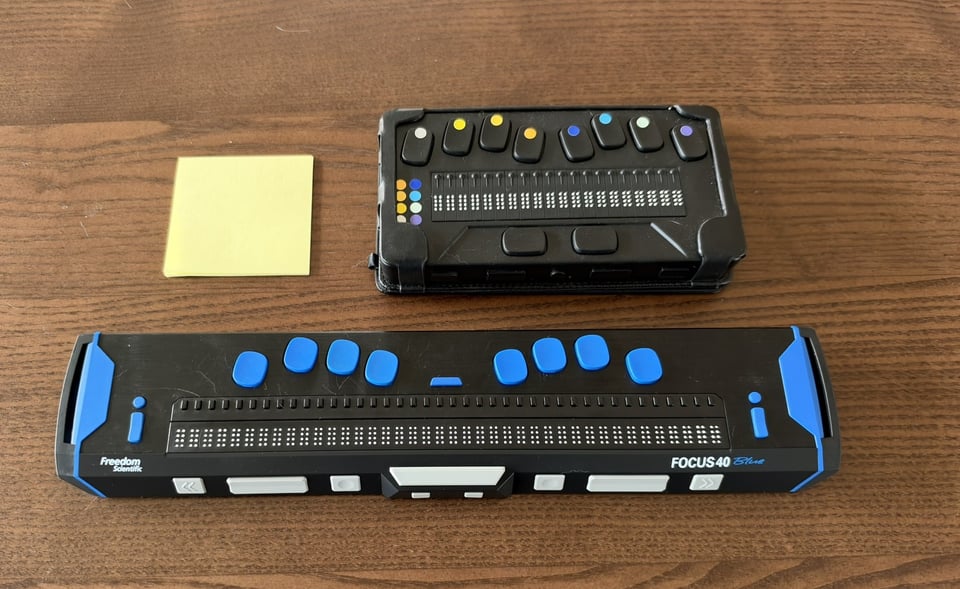
I've just upgraded from the starting braille display you can get for free on long-term loan from the Library of Congress's programs for the print-disabled to the Focus 40. Braille displays come with the serial number in braille, which means I've now made the happy discovery that I'm now just about literate enough to guess which way is up when presented with novel Braille on a movable object. Exciting!
It’s absolutely wild to have gone from not being able to label a braille cell by dot number in August to being able to navigate contracted braille menus independently in the dark in November. Still a long way to go for fluency, but it turns out you don’t need fluency for braille to be an accessibility game-changer.
AI usage note: This newsletter was wholly written by a human (including alt text image descriptions) and checked for spelling and grammar with Grammarly. Any remaining spelling and grammar errors are ARTISINAL. AI was used to source a non-technical article about tactile movement patterns.
Want more like this?
Shoutout here to my incredible tutor, Micah of [Tech Vision](Dr Denise M Robinson Mission and Purpose | TechVision – Access Tech for Blind & Low Vision Learners) ↩
I get so excited in elevators now because I can use the Braille instead of crouching near the buttons to pick a floor. ↩
If you're thinking, "Sixty-four things to memorize, not too bad!" boy, do I have news: those cells have contextual meaning - for contracted grade 2 Unified English Braille - the official tactile language of the US - there are actually about 200 cells and cell combinations to learn, and that's before you even get into punctuation. And if you want to get into math? That's a whole other essay.